The Ghost Warriors of the Archipelago
Why Pencak Silat Was Forged for Survival, and Why Its Blade Was Always Governed by a Code
By Hussein Udom
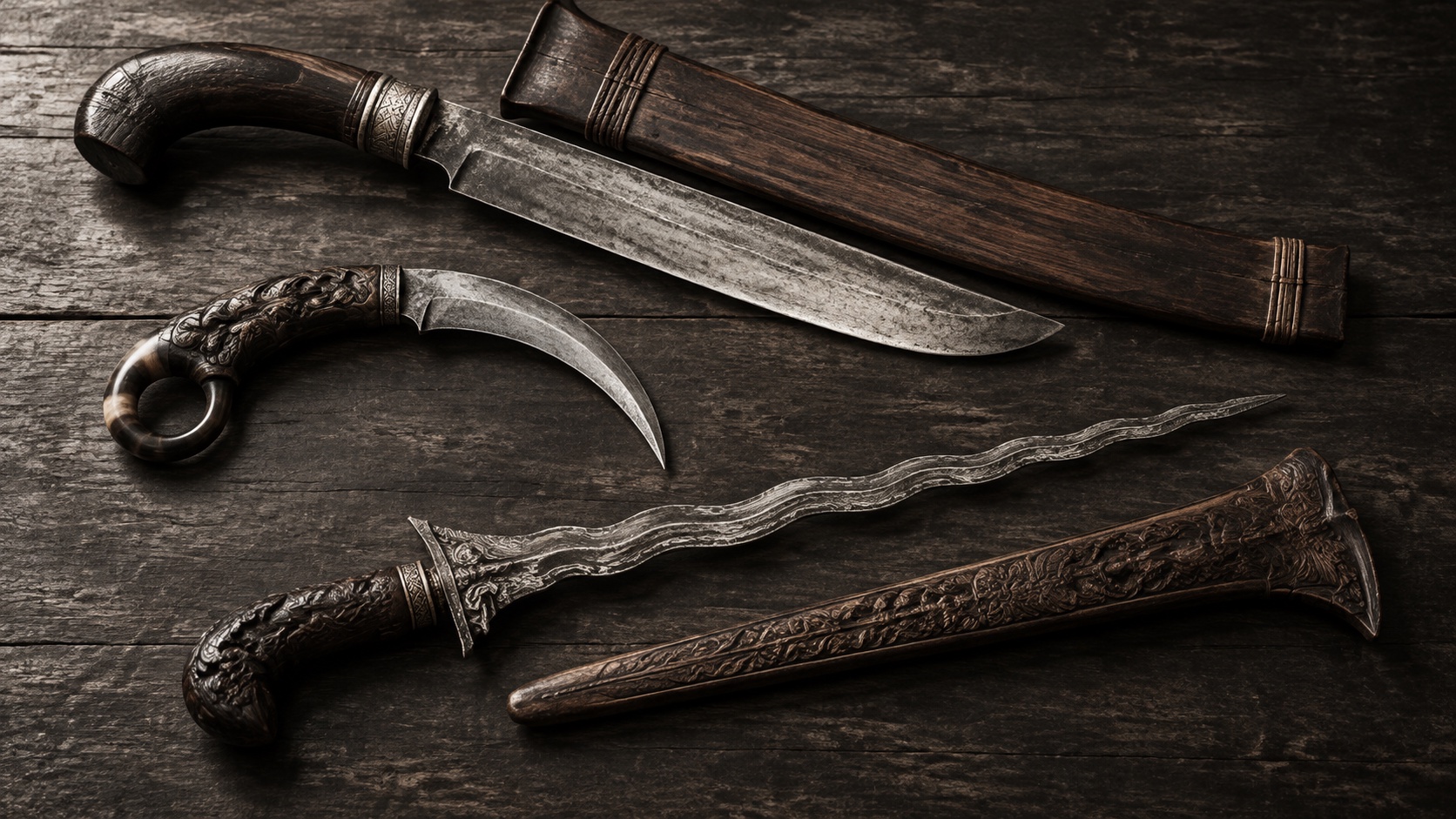
I love this art. I say that first, because everything that follows is written by a man defending something he loves, and a man who loves something does not speak about it softly when it is being cheapened.
You have seen it on screen. Elbows in hallways, bodies through walls, a karambit spinning like a toy. Beautiful. Thrilling. And almost entirely beside the point. That is the costume of Pencak Silat. It is not its heart.
Here is the heart, and I will not dilute it: Pencak Silat is a doctrine of asymmetric survival. It was carried by people who were outgunned, outnumbered, and out-resourced, and who refused to be erased. And every serious lineage understood one truth that the modern world keeps forgetting. Lethality without a code does not make a warrior. It makes a predator. The archipelago produced fighters precisely because it refused to produce predators.
Hold that sentence. Everything in this essay is built on it.
What Pencak Silat Actually Is
Pencak Silat is the family of martial traditions native to the Indonesian-Malay archipelago: Java, Sumatra, Bali, the Malay Peninsula, Mindanao, and beyond. Pencak is the visible form, the movement, the art. Silat is the application, the fight itself. One is the sheath. The other is the blade. Strip away either and you no longer have the tradition.
It was never one system. It is hundreds of lineages, shaped by village, court, coast, and mountain. But they share a spine: weapons first in mind, the empty hand as an extension of the weapon, the ground as an ally, and the teacher’s demand that character be built before the deadliest knowledge is handed over.
Pencak is the form. Silat is the fight. A man who only has the first is a dancer. A man who only has the second is dangerous to everyone, including himself.
Respect the Ring. Then Leave It.
Let me be absolutely clear, because lazy martial artists love this fight and I have no patience for it. Boxing, wrestling, Brazilian Jiu-Jitsu, Muay Thai, judo: these are magnificent. They give you something no compliant partner ever will. A human being who is genuinely trying to break your plan. That is honesty, and honesty is the rarest thing in martial arts.
Sport teaches timing that cannot be faked. It teaches distance under fire. It builds lungs, legs, and the nerve to keep thinking when your body is screaming. If you are not pressure-testing, you are guessing. Get in the ring. Bleed a little. Be humbled. It will make you better at everything I teach.
- Live resistance: the only teacher that never lies to you.
- Timing and distance: earned against a moving, thinking opponent.
- Conditioning: the engine every other skill runs on.
- Composure: the ability to stay a man when fear wants you to become an animal.
But never confuse the ring for the world. A sport is a contract. Agreed rules, one opponent, no weapons, a referee, a bell. Combatives begin where every one of those guarantees is gone. The second man you didn’t see. The blade you didn’t know was there. The concrete beneath you. The doorway behind you that just closed. Sport is the forge. Combatives is the war the forge was preparing you for.
Train in the ring to become honest. Train in combatives to stay alive. Never let one pretend to be the other.