Your Ultimate Guide to the Keris: Dagger of Life and Death
Everything you need to know about the deadliest and most celebrated daggers of the Nusantara
By Steve Hanafi and Hussein Udom
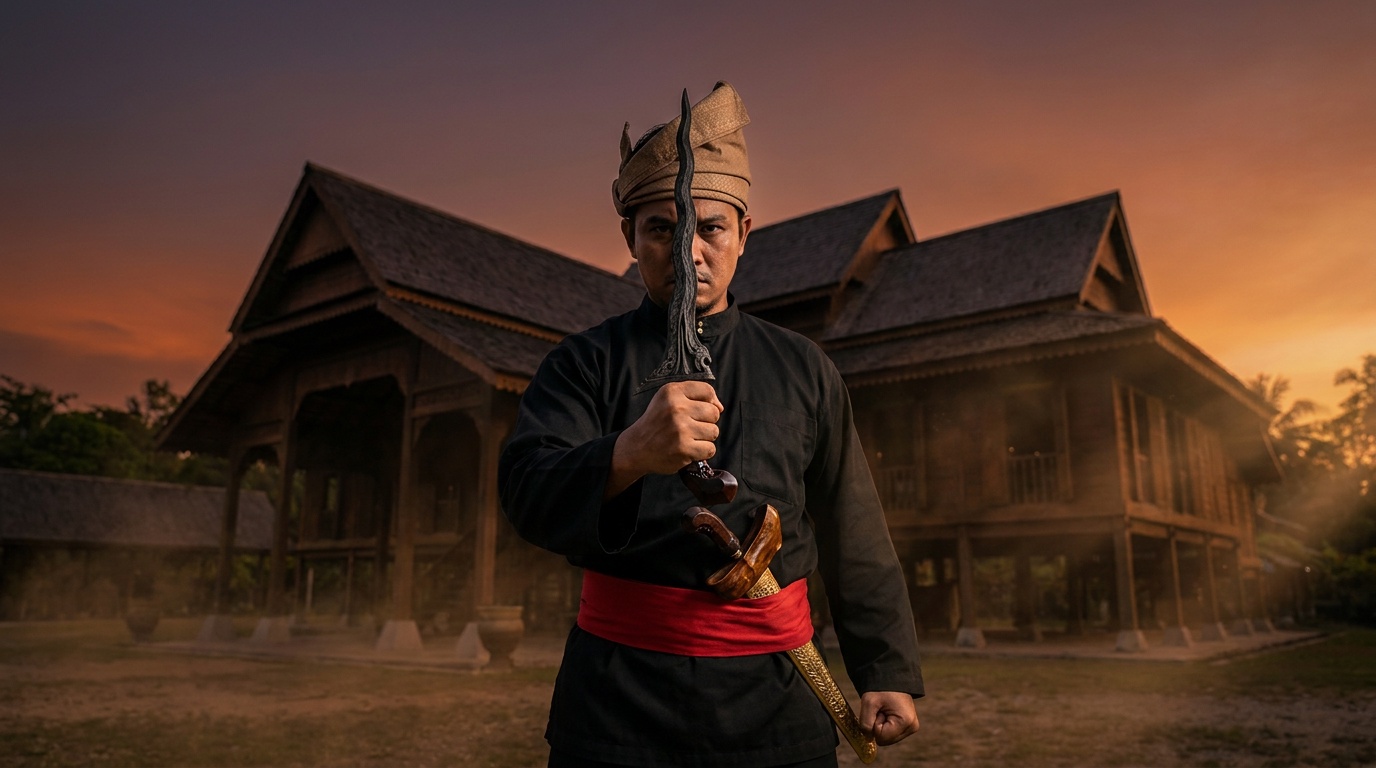
Every civilisation forges one weapon that tells the truth about it. The Romans had the gladius. The Japanese had the katana. The Nusantara has the Keris.
It is a dagger, and it is far more than a dagger. It is a royal regalia, an identity card, a prayer hammered into steel, and a killing tool that was feared across the Malay Archipelago for more than a thousand years. Sultans were crowned with it. Warriors died with it in their hands. Families still keep it wrapped in cloth and speak of it in a lowered voice.
This guide is the base text. Everything you need to know about the Keris, from the forge to the battlefield, from the hilt to the legend, is here. Read it once to learn it. Return to it whenever you need the truth about this blade.
Origins of the “Dagger of Legends”
The Keris is one of the most iconic and revered weapons of the Nusantara, the region which is now mostly known as Malaysia and Indonesia. One of the earliest Keris ever found was believed to be from the 5th century in central Java, the main island of Indonesia. It is a dagger-like weapon famously used by warriors, rulers, and commoners alike in early Nusantara Kingdoms in the Malay Archipelago and was considered as one of the most recognized symbols of the Nusantara.
According to Zainuddin and Shahrim in their book Senjata Warisan (2007), the name Keris originates from ancient Javanese, “Malang Kerik” which means to hold one’s arm at his waist. This was a reference to the figure of a person holding his arm at his waist which was carved at the hilt of the Keris in the early stages. Another belief is that the word Keris is from the verb “ngeris” which means to stab or pierce in Javanese language.
One of its most unique and intriguing features is the double-edged wavy blade that comes with the elaborately carved hilt and sheath. But the Keris isn’t just a weapon. It is a symbol of class, an identification of where you’re from, and a ceremonial symbolic and coronation regalia for royalty. In this respect it is used to symbolize the transfer of authority, power, and responsibility to a new Sultan until today.
It can be also seen on many coats of arms such as the Malaysian Army (Tentera Darat) and the Royal Malaysian Police Force (Polis Diraja Malaysia). Generally, the Keris can be divided into 7 different types which are: Keris Semenanjung, Keris Pekakak, Keris Jawa, Keris Sumatera, Keris Bali, Keris Bugis, and finally Keris Sundang. Each has different materials and designs but all are equally stunning in their manufacture.
- Keris Semenanjung
- Keris Pekakak
- Keris Jawa
- Keris Sumatera
- Keris Bali
- Keris Bugis
- Keris Sundang
The Keris Maker or “Pandai Keris”
The person who forges the Keris in Malaysia is known as Pandai Keris, or in our brother country, Indonesia, as Empu Keris. The process of making a Keris is very detailed, intricate, and strict. And it generally takes weeks, months, and sometimes a whole year to finish a more complex piece. Usually, the Empu Keris either learns it with a teacher or it is passed down from the previous generation, such as from father to son.
Understand what that means. The smith was not a tradesman selling a product. He was the keeper of a lineage. His hands carried what his father’s hands carried, and his father’s before him. When he struck the steel, generations struck with him.
The Philosophy behind Keris
Unlike forging other typical knives, the making of Keris has its own philosophies, such as the Lok (wave) of the Keris, with each curve having meaning beyond the obvious fighting element. Lok 5 represents the 5 pillars of Islam, Lok 7 represents Tawaf (Islamic ritual of pilgrimage in Mecca), and Lok 13 represents the 13 Rukun Solat, the fundamentals of prayer. Before the arrival of Islam in the Nusantara, Hindu and Buddhist beliefs had primary influence on the philosophy of the Keris via the Singhasari Empire, their successors the Majapahit, and the Sriwijaya Empire which was one of the earliest pre-Islamic Malay kingdoms. It was believed that the origin of the carving of the hilt was from a Buddha statue, but as Islam came, the carvings were changed into animals and other motifs.
The Lok, the signature wave of the blade, was always set in an odd number, because an even number is considered perfection, and nothing is perfect except God himself. Odd represents a flaw, hence most Keris have an odd Lok which is representative of the human being who has his flaws as well. However, there are a few Keris out there with an even number of Lok, this symbolized that it was the last Keris to be made by the Empu.
The Sampir (boat-shaped crown) symbolizes the shape of a classical Perahu (boat), which is why it is sometimes called Perahu Keris. The philosophy behind it is that the blade of the Keris represents a person who is a sailor, the Lok represents the wave of the sea, and the Sampir is the boat or ship. The sea is a powerful identity of the Archipelago people and captured beautifully in the sobriquet used to refer to the Nusantara: “Tanah Air”, which literally means Land of Water. The philosophy of the Sampir teaches a lesson of strategy which the ancient empires felt was imperative: Those who conquer the sea, conquer the world.